A programme that simply issues invoices is not enough
If the system does not share data with sales, accounts, logistics or document management, there is a risk of duplication and incomplete traceability.
ERP, VeriFactu, POS, WhatsApp and AI with local support from Mallorca.
Electronic invoicing must not exist in isolation from ERP. It must be integrated with customers, tax authorities, government bodies, accounts, warehousing and document workflows. That is why we are developing a connected architecture, ready for VeriFactu and ahead of the curve when it comes to the evolution of electronic invoicing.

If the system does not share data with sales, accounts, logistics or document management, there is a risk of duplication and incomplete traceability.
Series, customers, taxes, statements, collections, stock and journal entries must all follow the same logic. Otherwise, the process breaks down precisely where it is most difficult to correct.
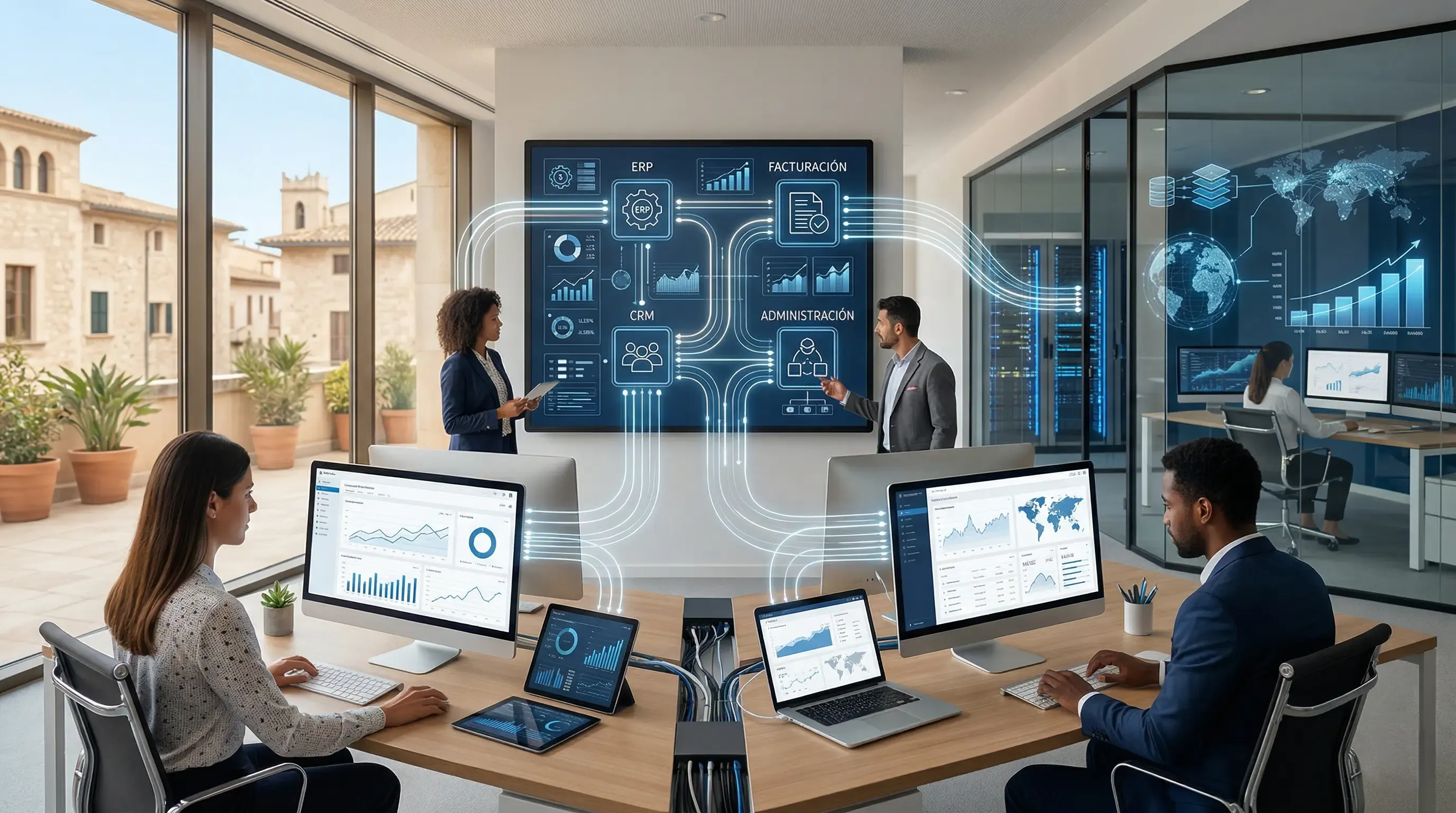
The question is not simply whether you can issue an invoice. The question is how that invoice fits in with the rest of the system and with the people who use it on a daily basis.
When office systems, e-commerce platforms, points of sale and bespoke solutions are used together, electronic invoicing must be integrated with all of them without creating manual exceptions.
Architecture should facilitate communication with the accountancy firm without turning every month-end into a process of data collection and cleaning.
We work with real-world integrations: APIs, queues, validations, monitoring and error handling to ensure the architecture remains operational.
You can also find out more on our page at ERP for SMEs, in the current service of No text provided a soft landing retail with a physical POS terminal and on the landing page aimed at accountancy and consultancy firms.
We identified ERP, satellite software, data entry points and critical dependencies.
We define how VeriFactu, electronic invoicing, financial statements and business processes fit within the same architecture.
We adjust data models, events, APIs and validations to prevent inconsistencies between systems.
We validate real-world scenarios, data errors and monitoring points prior to commissioning.
We support the roll-out with technical expertise and strategic vision as the regulatory framework evolves.
Qué cambia en la gestión de estados, aceptación y pago cuando la factura electrónica B2B se incorpora al flujo real de empresa y despacho.
Abrir recursoLas diferencias entre ambos cambios y por qué conviene prepararlos con una base técnica y operativa coordinada.
Abrir recursoUn resumen claro del marco aprobado y de los pasos regulatorios y técnicos que todavía deben desplegarse.
Abrir recursoVisión completa para empresas, gestorías y entornos ERP que necesitan preparar el cambio con una solución ya implantada.
Ver esta landingEnfoque operativo para despachos que necesitan orden, trazabilidad y mejor coordinación con sus clientes.
Ver esta landingIt depends on ERP and the current level of integration. When invoicing affects several processes, a standalone module often falls short and creates more friction in the medium term.
Not necessarily. The first step is to analyse the current architecture and decide what to adapt, what to integrate and what is best left untouched.
VeriFactu underpins record-keeping, traceability and technical control. That is why we integrate it into the overall framework rather than treating it as a task separate from the other processes.
Yes. When there is regular data exchange between a company and a law firm, a well-designed architecture reduces duplication and improves data consistency.
It allows the technical infrastructure to be organised before regulatory requirements force us to rush. This reduces the costs associated with urgent work, rework and poorly planned integrations.
If you need to organise ERP, ensure compliance and implement integrations within a single architecture, we’ll start by reviewing your current situation and the actual scope of the change.
Capacidades clave del ERP
Función principal
La IA del ERP ayuda a leer facturas con OCR, resolver dudas operativas y consultar datos reales según permisos. Reduce tareas manuales y mantiene revisión del usuario.
Función principal
Cuando emites una factura, el sistema puede identificar por NIF/CIF si el receptor también usa Grupo Gampi y entregarla en su ERP. Menos emails sueltos y más trazabilidad entre empresas conectadas.