Greater traceability
Relevant information is no longer hidden away in email chains or manual exchanges. The firm gains a clearer picture of what has been issued, what has been accepted and what is still pending.
ERP, VeriFactu, POS, WhatsApp and AI with local support from Mallorca.
When information arrives late, in a fragmented state or without a common framework, the problem is not just invoicing: it is maintaining an orderly workflow. That is why we have developed a system designed to provide greater traceability, reduce administrative friction and improve coordination with the client.

In many firms, the workload does not stem solely from issuing or checking invoices. It comes from chasing up documents, correcting data, interpreting statements and liaising with clients who do not always have the same operational structure.
If that groundwork is not put in place now, any progress on VeriFactu or e-invoicing will put further pressure on a process that is already stretched to the limit.
Relevant information is no longer hidden away in email chains or manual exchanges. The firm gains a clearer picture of what has been issued, what has been accepted and what is still pending.
It reduces the repetitive work of tracking down documents, reinterpreting statements and re-entering data before the close.
A connected database enables work to be carried out in a more consistent manner across the office and the company, with less reliance on manual data entry.
When data is generated in a structured and traceable format, it becomes possible to automate validations, reminders and reconciliations.
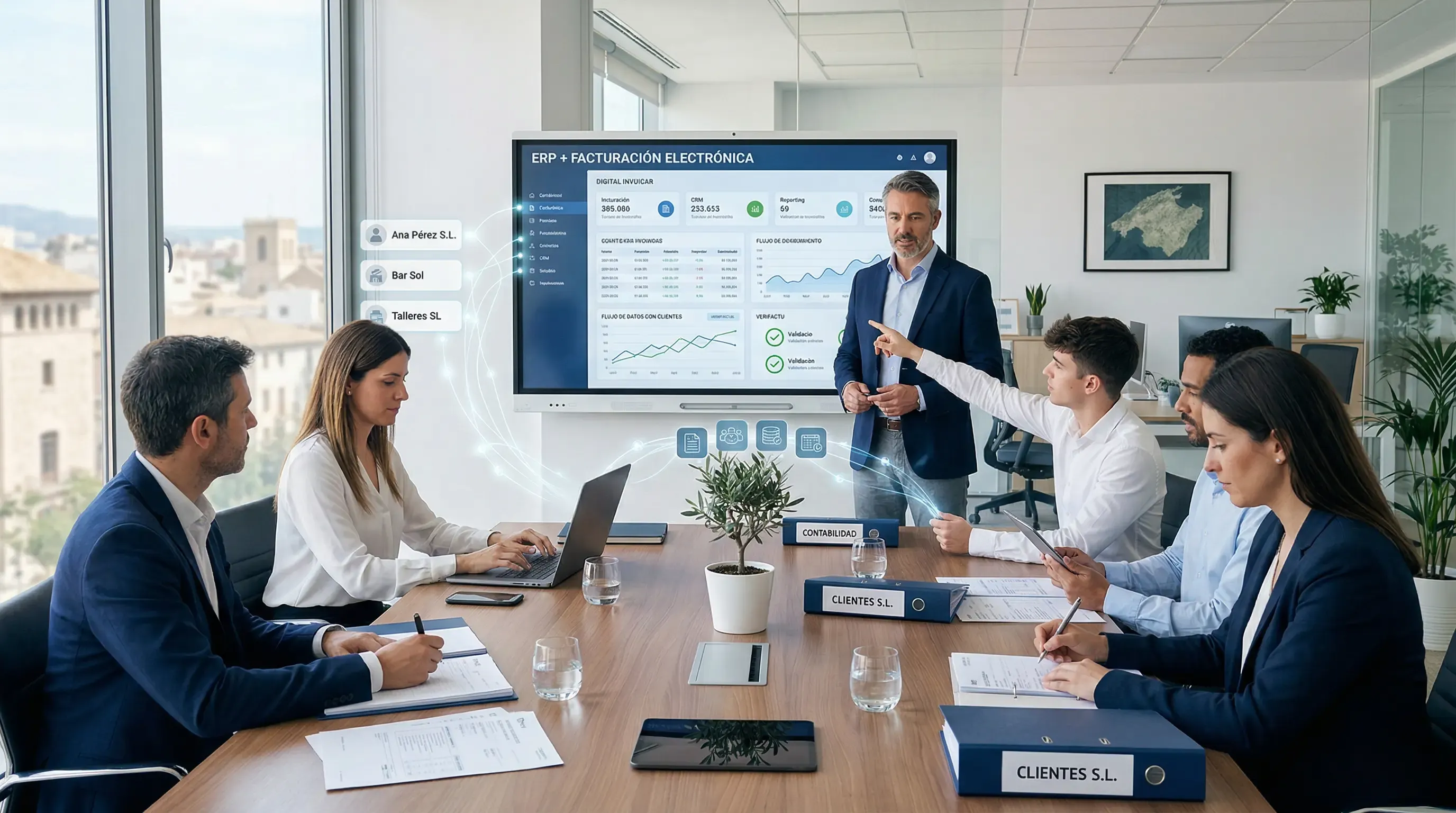
VeriFactu and electronic invoicing should not be confused, but they do need to be coordinated. One relates to record-keeping and traceability; the other to the structure and exchange of invoices between companies.
That is why we recommend reviewing the firm’s operations, client relations and working relationship with ERP all at the same time. If you’d like an overview, you can find it on our main landing page at electronic invoicing.
It is not enough simply to add a layer of documentation. Improvement comes when the dispatch team, the client and the software all operate according to clearer criteria.
We tailor the solution to the way your team works: document review, project closures, client enquiries and internal coordination.
Not all your customers will have the same ERP or the same level of digital maturity. We design a structured framework to manage this diversity without losing control.
If the firm or the client is already using a ERP, the key is to integrate it properly. That is why we link the electronic invoice to the operational logic and not just to the final document.
If your priority is ensuring the system works seamlessly with your existing management system, you can also take a look at our page on electronic invoicing in ERP and integrations, in addition to the current service provided by ERP for SMEs and the page for No text provided.
Qué cambia en la gestión de estados, aceptación y pago cuando la factura electrónica B2B se incorpora al flujo real de empresa y despacho.
Abrir recursoLas diferencias entre ambos cambios y por qué conviene prepararlos con una base técnica y operativa coordinada.
Abrir recursoUn resumen claro del marco aprobado y de los pasos regulatorios y técnicos que todavía deben desplegarse.
Abrir recursoVisión completa para empresas, gestorías y entornos ERP que necesitan preparar el cambio con una solución ya implantada.
Ver esta landingArquitectura, integraciones y convivencia con el ERP para empresas y despachos con procesos conectados.
Ver esta landingYes. It is designed for firms that need to work in a more organised manner, with better traceability and less reliance on manual communication with their clients.
Not always straight away. It depends on each client’s starting point and the systems already in place. The aim is to gradually reduce that dependence by creating a better-connected infrastructure.
Yes. The firm should also review how VeriFactu fits in, the development of electronic invoicing, and its own process for issuing and tracking invoices.
Yes. Indeed, a significant part of the work involves analysing what ERP currently exists, what exchanges take place, and how to organise the integration without duplicating operations.
Because critical work doesn’t begin when a deadline arrives. It begins by organising processes, responsibilities and databases so that the subsequent technical roll-out doesn’t catch the office off guard.
We review your operations, customer flow and how your system works alongside ERP or your current software to draw up a realistic plan.